Book talk in Kyoto & Silent Sparks on sale in Tokyo!



Book talk in Kyoto & Silent Sparks on sale in Tokyo!
While fireflies were harvested for their light-producing chemicals in the U.S., in Japan fireflies were harvested for their beauty. In Japan’s Shiga Prefecture, many firefly merchants set up shop very summer from the early 1800s through the 1920s. They hired hunters to collect genji-botaru (Luciola cruciata) fireflies, which they sold to clients in Osaka, Tokyo, and Kyoto. Hotel and restaurant owners released these wild-caught fireflies into their gardens, where customers would pay to enjoy their luminous beauty.
By some estimates, firefly vendors sold three million wild insects to city folk every June and July. Soon, firefly populations began to dwindle due to over-collecting, river pollution, and habitat loss.
Silent Sparks describes the ecohistory of Japanese and U.S. fireflies, including some successful conservation efforts.
From Mark G. in Tokyo-
Summers were full of lightning bugs where I grew up in West Virginia. When the first ones came out at dusk,  we’d catch them easily with our hands. But it got a lot harder to catch the ones that came out later after dark. So then my sister and I would take to whacking the fireflies out of the air with our Fun-go baseball bats.
Once our bats were good and gooey with lightning bugs, we’d swirl them around to trace glowing figures in the dark, until Mom finally called us in to bed.
Editor’s note: This apparently uniquely American pastime of bashing lightningbugs is confirmed here and here and here.
In Japan, fireflies are called hotaru (ほたる) and they’re a summertime insect just like in the U.S. Although about 40 different firefly species live here, Genji and Heike fireflies are the most popular.

Luciola cruciata
Unlike U.S. fireflies, these two species have an aquatic larval stage, so they are commonly found around rivers and streams (Genji fireflies) or rice-fields (Heike fireflies). They’re so popular they even appear on stamps & manhole covers!


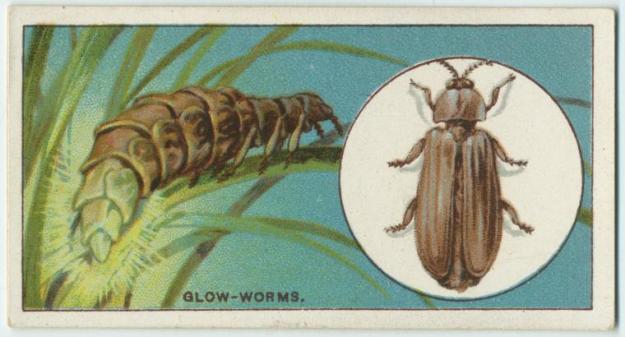
1922 Wills cigarette card
During the last century, many cigarette manufacturers tucked nifty collectible cards inside every cigarette pack. Sometimes these cigarette cards had wonderful artwork depicting fascinating scientific tidbits. This 1922 card of the common European glow-worm show both a male (right, inside circle) and a female (left, on grass). The two look surprisingly different in this and other glow-worm species! While the male looks like a pretty typical adult beetle, the grub-like female doesn’t: for one thing, she doesn’t have wings, so she’ll never be able to fly. Full of eggs, this plump female crawls up onto a perch and glows for hours trying to attract a flying, unlit male.
The glow-worm’s undeniable romantic charm was also captured in this hit song, which the Mills Brothers recorded in the 1950s – enjoy!
Believe it or not, from 1960 until the mid-1990s, the Sigma Chemical Company (now called Sigma-Aldrich) harvested about 3 million wild fireflies every year. Each summer, they ran newspaper ads to recruit thousands of collectors across the U.S., who got paid a penny per firefly (with a $20 bonus if they sent in more than 200,000 fireflies).


What did they do with all those fireflies?
I love this story about Japanese fireflies (from a 2003 PureLandMountain blogpost) –
Stop what you’re doing and watch this short video taken in Samut Prakan province, Thailand. Turn off the lights, go full screen, and get ready to be blown away by thousands of male fireflies regularly synchronizing their flashes to attract females. They synchronize naturally, although here the fireflies (known as Pteropytx malaccae) have been triggered by some flashing LED lights. This video is part of a 2015 installation work by Robin Meier & Andre Gwerder, it’s called “Synchronicity (Thailand).”
You can also watch some spectacular displays of the U.S. synchronous firefly, Photinus carolinus, which lives parts of North Carolina, Tennessee, and Pennsylvania. You can read more about these traveling synchronizers in Silent Sparks (Chapter 2: Lifestyles of the Stars).
Produced by Audemars Piguet Art Commission, Le Brassus
Director of Photography: Nikolai Zheludovich; Editing: Mariko Montpetit
Special thanks to Anchana Thancharoen and her team at Kasetsart University, Bangkok
For my parents –
They lived and loved together for nearly ninety years, and fed us wonder when we were very young.
Silent Sparks is dedicated to my mother and father, who lived to the venerable ages of 95 and 99, respectively. And they were five years old when they first met.
 They showed me how to appreciate the natural world. I grew up a wild child, roaming free. I swam under sparkling waterfalls, wandered through mysterious hemlock forests, and slept beneath brilliant night skies. Early on, I got hooked on life’s diversity. They loved to learn about my scientific adventures with fireflies. So when I decided two years ago to write a popular book, they were especially delighted.
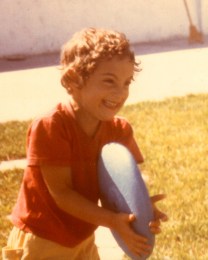
Author, capturing wonder (ca. 1956)
I’m writing this post during the darkest days of December. Just a few weeks ago, my Dad exhaled his last breath. He was ancient, but he was never old. He used his iPad to keep up on world news, and days before he died he completed the Sunday New York Times Crossword, in pen, as always. Dad Skyped daily with relatives and friends – although scattered through space, these lifelong friends showed up for daily visits in his living room.
Though my parents will never get the chance to read Silent Sparks, I will remain eternally grateful to them for the gift of wonder. So that’s why I dedicated this book to them.


From a retired science teacher in St. Louis, Missouri:

When my mother was young, she slipped out one evening with her Mason jar to collect some fireflies. As she ran through the grass, she tripped and fell on a rock, and the jar shattered in her hands . A sharp glass shard sliced its way through her finger. Even though she eventually lost that finger, she never did lose the love she had for these silent sparks.
 Silent Sparks