Launching the Firefly Genome!

Thrilled to announce that the Firefly Genome Project will soon start deciphering the genetic blueprint of the U.S. Big Dipper firefly, Photinus pyralis!

More than 80 people from many different countries helped us crowdfund this path-breaking scientific initiative by contributing & by spreading the word – thanks to all!

And another great thing is that we’ll be providing open access to the DNA sequence data, which we hope will inspire lots more exciting firefly science in the future.

You can learn more about the goals & progress of this collaborative project at Experiment.com.

Loving Chinese fireflies to death?

china valentines day.jpg

For the past few years, online sales of live fireflies have skyrocketed just before Qixi, the Chinese equivalent of Valentine’s Day. For many young Chinese, a jar of fireflies looks like a brilliant way to say “I love you.”

According to reports, more than 10 million Chinese fireflies were sold online in 2015, a tenfold rise compared with the same period the previous year. Costing a few hundred yuan, each  container holds 30-50 fireflies, most likely collected from the wild. But it makes a short-lived gift, because once they’re in captivity these fireflies will only survive a few days. Continue reading

Japanese Fireflies: Harvested for Beauty

While fireflies were harvested for their light-producing chemicals in the U.S., in Japan fireflies were harvested for their beauty.catching fireflies print In Japan’s Shiga Prefecture, many firefly merchants set up shop very summer from the early 1800s through the 1920s. They hired hunters to collect genji-botaru (Luciola cruciata) fireflies, which they sold to clients in Osaka, Tokyo, and Kyoto. Hotel and restaurant owners released these wild-caught fireflies into their gardens, where customers would pay to  enjoy their luminous beauty.

By some estimates, firefly vendors sold three million wild insects to city folk every June and July. Soon, firefly populations began to dwindle due to over-collecting, river pollution, and habitat loss.

Silent Sparks describes the ecohistory of Japanese and U.S. fireflies, including some successful conservation efforts.


Lightningbug baseball

From Mark G. in Tokyo-

Summers were full of  lightning bugs where I grew up in West Virginia. When the first ones  came out at dusk, 1590_0201_1we’d catch them easily with our hands. But it got a lot harder to catch the ones that came out later after dark. So then my sister and I would take to whacking the fireflies out of the air with our Fun-go baseball bats.
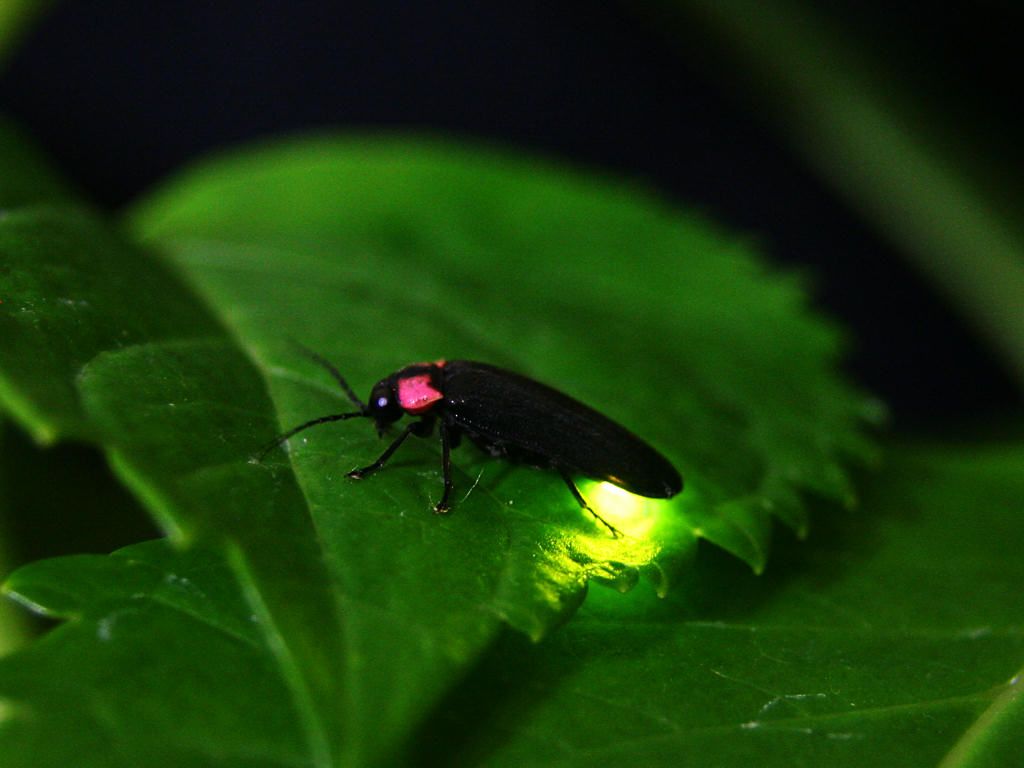
Once our bats were good and gooey with lightning bugs, we’d swirl them around to trace glowing figures in the dark, until Mom finally called us in to bed.

Editor’s note: This apparently uniquely American pastime of bashing lightningbugs is confirmed here and here and here.

Fireflies in Japan

In Japan, fireflies are called hotaru (ほたる) and they’re a summertime insect just like in the U.S. Although about 40 different firefly species live here, Genji and Heike fireflies are the most popular.

hotaru_005

Luciola cruciata

Unlike U.S. fireflies, these two species have an aquatic larval stage, so they are commonly found around rivers and streams (Genji fireflies) or rice-fields (Heike fireflies). They’re so popular they even appear on stamps & manhole covers!

Glow-worms in pop culture

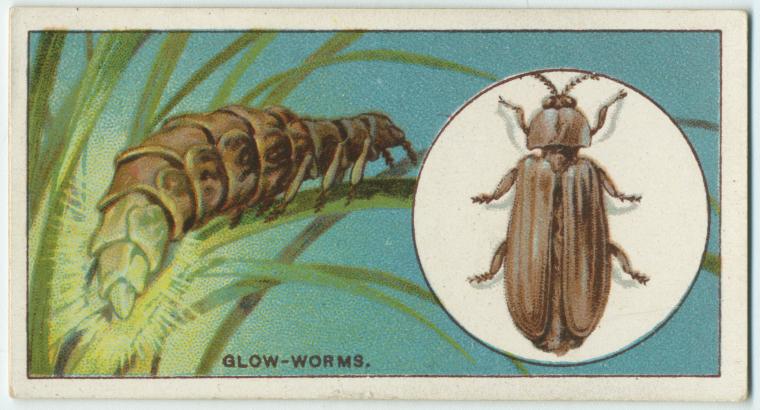
Glowworm Wills cigarette card

1922 Wills cigarette card

During the last century, many cigarette manufacturers tucked nifty collectible cards inside  every cigarette pack. Sometimes these cigarette cards had wonderful artwork depicting fascinating scientific tidbits. This 1922 card of the common European glow-worm show both a male (right, inside circle) and a female (left, on grass). The two look surprisingly different in this and other glow-worm species! While the male looks like a pretty typical adult beetle, the grub-like female doesn’t: for one thing, she doesn’t have  wings, so she’ll never be able to fly. Full of eggs, this plump female crawls up onto a perch and glows for hours trying to attract a flying, unlit male.

The glow-worm’s undeniable romantic charm was also captured in this hit song, which  the Mills Brothers recorded in the 1950s – enjoy!


We harvested 100 million U.S. fireflies?

Believe it or not, from 1960 until the mid-1990s, the Sigma Chemical Company (now called Sigma-Aldrich) harvested about 3 million wild fireflies every year. Each summer, they ran newspaper ads to recruit thousands of collectors across the U.S., who got paid a penny per firefly (with a $20 bonus if they sent in more than 200,000 fireflies).

What did they do with all those fireflies?

They extracted firefly luciferase, the light-producing enzyme, then sold it for use in food safety testing and research.

Continue reading

Little Green Stars (from Robert Brady)

I love this story about Japanese fireflies (from a 2003 PureLandMountain blogpost) –

Tonight we chased a sliver of a moongrin across the big bridge over the Lake to take Kaya (2 1/2 years old now) to a famed hotaru (firefly) stream … down through the deep dark to the firefly kingdom along the stream in its place beneath the tall trees, where the even deeper darkness was lit like a microstarry night with nothing but wisping flights of limegreen, surprisingly bright flashes rising, swooping, curving, softly floating, flitting here and there going on and off, sparkles resting in their hundreds on the leaves or falling sudden to the ground, kids, mothers, fathers and grandfolks trying to coax the little green stars to their hands, everyone glowing with the mysterious green fire that reflected in the eyes, the faces lit with awe and Kaya too was wide-eyed watching light walk in her hand.

Synchronicity

Stop what you’re doing and watch this short video taken in Samut Prakan province, Thailand. Turn off the lights, go full screen, and get ready to be blown away by thousands of male fireflies regularly synchronizing their flashes to attract females. They synchronize naturally, although here the fireflies (known as Pteropytx malaccae) have been triggered by some flashing LED lights. This video is part of a 2015 installation work by Robin Meier & Andre Gwerder, it’s called “Synchronicity (Thailand).

You can also watch some spectacular displays of the U.S. synchronous firefly, Photinus carolinus, which lives parts of North Carolina, Tennessee, and Pennsylvania. You can read more about these traveling synchronizers in Silent Sparks (Chapter 2: Lifestyles of the Stars).

Produced by Audemars Piguet Art Commission, Le Brassus
Director of Photography: Nikolai Zheludovich; Editing: Mariko Montpetit
Special thanks to Anchana Thancharoen and her team at Kasetsart University, Bangkok