
One summer when he was about six, my nephew Nate got totally traumatized by fireflies. Delighted at first sight, he skipped and jumped as they lit up our field, collecting a dozen or so in a mason jar. That night he fell asleep happy, mesmerized by the soft glow from his bedside jar.
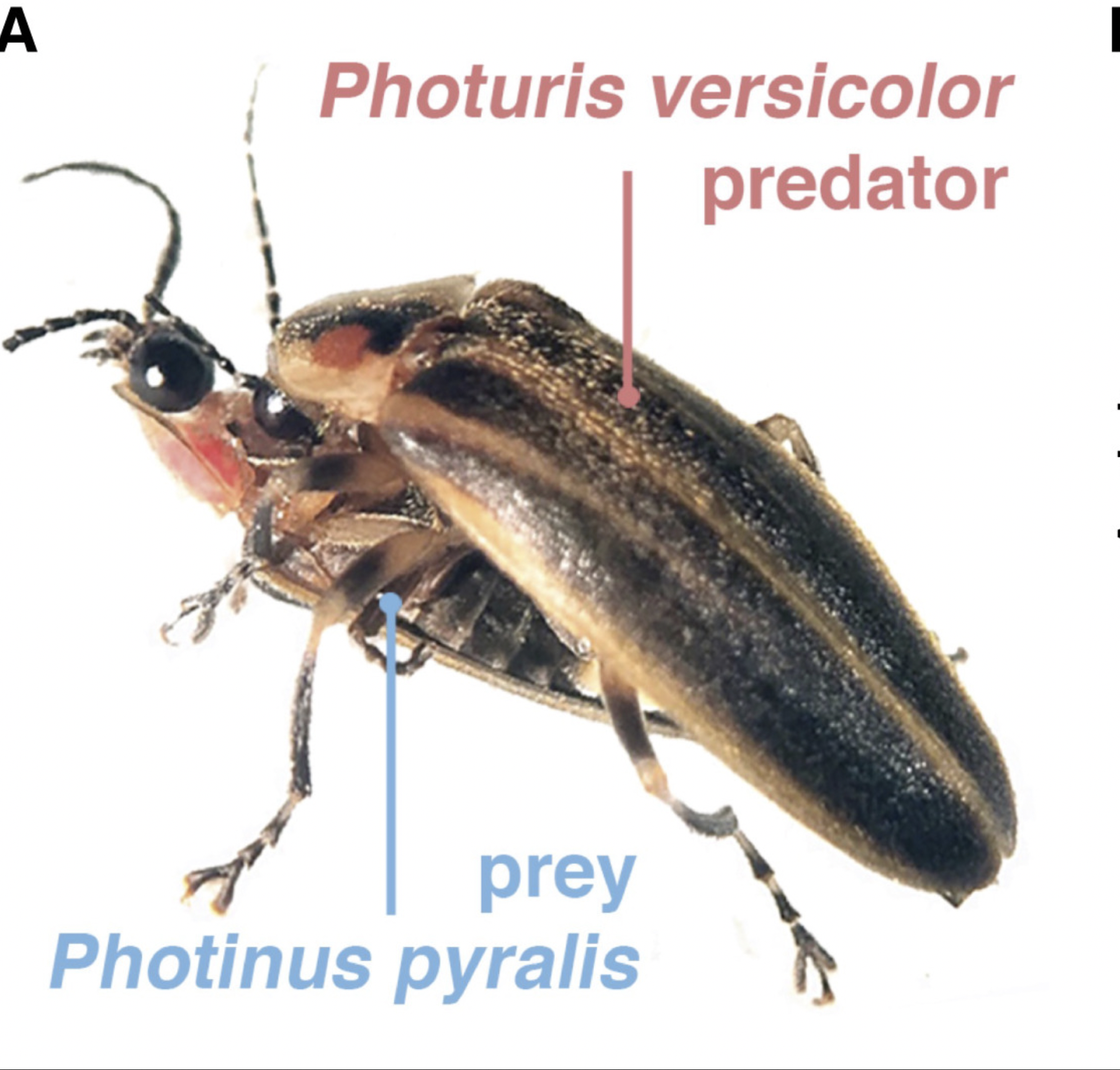
But next morning we awoke to terrified screams of “Help, come quick!” Peering into the jar, we recognized a gory scene: all that remained of last night’s collection was a single firefly – it was a really big Photuris female – and she was busy sinking her mandibles into the neck of a hapless Photinus male. Still alive (barely), he was the last survivor; all that remained of the other captive fireflies were bits and pieces scattered on the bottom of the jar.
Blueberry pancakes soothed, but these firefly vampires made a lasting impression on Nate. You too can watch some gory action at the end of this KQED Deep Look video:
In general, fireflies don’t eat during their short adulthoods (instead, they pig out as juveniles). But the females of certain Photuris fireflies have evolved into voracious predators that are highly specialized to consume other firefly species. Nate had accidentally captured one of these vampire fireflies, and she had easy pickings in his mason jar.
In the wild, predatory Photuris females use several tricks to snag a firefly meal. They’re nicknamed femmes fatales because they often lure males by mimicking the courtship flashes given by females of their intended prey. They also pursue and attack flying males, and deftly steal trapped and wrapped fireflies from spiders’ webs (read more about this thieves-in-the-night strategy here).
What the heck is going on here?
Obviously insects don’t like to get eaten. Many gain protection by being toxic. If you’ve ever tasted a firefly (I do not recommend this! link), you’ll know they taste awful. And that’s because they contain defensive toxins called lucibufagins (loo-sa-boo-fa-jins).
We’ve known for about 50 years that Photinus fireflies manufacture lucibufagins, and these are very effective at deterring most insect-eaters. It’s also been known for decades that predatory Photuris fireflies resort to hunting and eating other fireflies because they’re unable to manufacture lucibufagins on their own.
Tolerating firefly toxins
But many mysteries remain! A big challenge has been figuring about how fireflies – this includes both the prey and the predator – avoid getting poisoned by their own toxins or the toxins they ingest. Recent work suggests the answer revolves around a piece of cellular machinery called the sodium-potassium pump. Lucibufagins and related toxins (generically known as cardiotonic steroids) kill predators by messing with an essential piece of cellular machinery. It’s a tiny molecule called the sodium-potassium pump. You, me, and every other animal rely on millions of these sodium-potassium pumps (NaK pumps) to think, contract our muscles and send signals along our nerves.
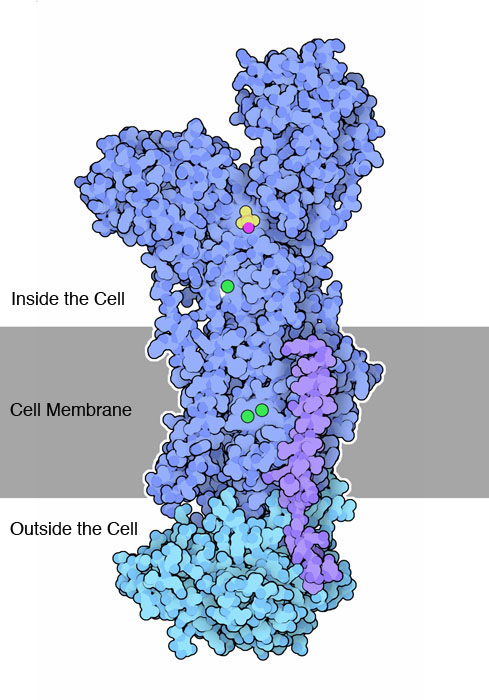
Tiny but mighty, sodium (Na)-potassium (K) pumps allow brains to think, nerves to signal, and muscles to contract.
(NaK Pump image by David Goodsell)
New insights
In a study published December 2023 in the journal Current Biology, Lu Yang and her colleagues discovered that predator fireflies and their firefly prey have evolved very different toxin resistance strategies.
Most toxin-producing fireflies contain a single, tweaked version of the NaK pump that enable them to avoid self-poisoning. In Photinus and other prey fireflies, this resistance depends on a single mutation in the toxin-binding part of the NaK pump that sits outside the cell membrane that swaps out one amino acid for another (isoleucine gets substituted for the alanine that normally sits at position 119 in the protein).
But more elaborate modifications show up in the NaK pump genes of predatory Photuris fireflies, and these apparently help them deal with toxins ingested from their prey. Photuris fireflies carry multiple gene copies that encode several different versions of the NaK pump – some versions are sensitive to toxins, while others are more resistant. The most resistant versions of their NaK pumps (ATP⍺1C and D) are expressed in the digestive tract of predatory females, the infamous femmes fatales.

Predatory Photuris fireflies carry multiple gene copies that encode several different versions of the NaK pump (ATP⍺1A-D), while Photinus prey have expres a single version expressed everywhere.
(from Yang et al 2023)
The authors conclude that confronted with distinct physiological challenges of manufacturing their own toxins vs. ingesting and sequestering them from prey, Photinus and Photuris evolved very different strategies to reduce toxic effects on NaK pumps in their own tissues.
Photinus manufacture their own toxins and express a single, highly resistant NaK pump throughout their bodies to avoid getting poisoned. But predatory Photuris fireflies have evolved multiple gene copies that encode different versions of the NaK pump – some more resistant, others less so – together with tissue-specific expression patterns that allow them to safely hijack and sequester toxins produced by other fireflies.
References (caution, possible paywalls)
Lu Yang, Flora Borne, Anja Betz, Peter Andolfatto et al. 2023. Predatory fireflies and their toxic firefly prey have evolved distinct toxin resistance strategies. Current Biology vol 33, pages 5160-68. https://doi.org/10.1016/j.cub.2023.10.063
Lynn Faust, Raphaël de Cock, and Sara Lewis. 2012. Thieves in the night: Kleptoparasitism by fireflies in the genus Photuris (Coleoptera: Lampyridae). The Coleopterists Bulletin Volume 66, pages 1-6. https://doi.org/10.1649/072.066.0101



 Silent Sparks