
Category Archives: Blog

Conspiring to be part of the ✨magic ✨!

Taiwan, ho!

I’m honored to be giving a keynote talk at the upcoming International Firefly Symposium in Taipei next April! Held every three years, this meeting gives firefly scientists and enthusiasts from all over the world a chance to gather and discuss the latest finding on firefly biology and conservation. Taiwan boasts more than 50 different firefly species, and has emerged as a leader in firefly conservation and habitat restoration.

taiwan

Meeting participants hail from 22 countries, including Thailand, Japan, China, Malaysia, Hong Kong, Australia, Vietnam, Laos, Sri Lanka, Belgium, Côte d’Ivoire, Mongolia, India, and Indonesia.

I’ll be speaking about “Emerging Directions in Firefly Research” – you can check out the other keynote speakers here.
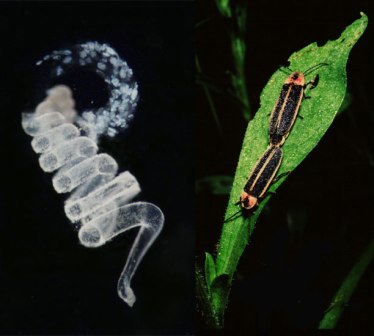
Shedding More Light on Firefly Sex

Natural selection is based on the struggle for survival, but sexual selection is driven by the struggle for reproductive opportunity. And sexual selection turns out to be quite a powerful evolutionary force – it’s the reason we can enjoy such melodious birdsong,  extravagant peacock tails,  gigantic deer antlers, and such spectacular firefly flashes!

We know that fireflies give bioluminescent courtship signals, but firefly sex goes way beyond flashing. While mating, many male fireflies give the female a spermatophore, which is an elaborate, sperm-containing package. This firefly “nuptial gift” represents a hefty male investment that’s entirely home-made: it takes several glands to manufacture each gift. Until recently, though, we’ve been largely in the dark about the composition of these mysterious gifts.

firefly gift and mating

Some firefly males give nuptial gifts (they’re actually really tiny)

Continue reading

Chinese Fireflies: An Encouraging Update

Many readers have spoken out against the commercial harvesting of wild fireflies in China, and nearly 10,000 people have signed a petition calling for a ban on such activity. In October 2016, The International Firefly Scientist Network wrote to the Chinese Ministry of Environmental Protection expressing our concerns about the negative impact of commercial harvesting on firefly biodiversity in China.

Last week, we received a  very thoughtful and encouraging response  from Mr. CHENG Lifeng, Director General of the Biodiversity Conservation Office.  I’m delighted to share with you the following excerpt: Continue reading

Can fireflies flee forest fires?

Following a summer of scorching drought, wildfires have ravaged parts of the southeastern United States. Last month, a devastating fire burned out of control through Gatlinburg, Tennessee.

chimneytops2fire_imt_photo-768x488

Chimney 2 forest fire burns in the Smoky Mountains (Nov 2016)

From its starting point in the Great Smokies National Park, the fire exploded into an inferno fanned by strong winds. For days, hundreds of firefighters battled the blaze. The Sevier County mayor called the combination of wind and dry tinder a “once-in-a-lifetime event…a perfect storm.” By the time they finally extinguished the fire, the charred landscape stretched across 17,500 acres. Fourteen people lost their lives, and nearly 200 were injured. Tens of thousands were forced to evacuate, and over 2400 homes and businesses were destroyed.

Continue reading

Finding Heaven – India’s Monsoon Fireflies

From Param and Shikha Singh, via The Untourists

At the onset of the monsoons in early June, we traveled to a small village near Sangamner in rural Maharashtra. We went to Purushwadi, a tiny village 1000 m above mean sea level, based only on some promises we’d heard. During this season, this valley was said to transform into a heaven of fireflies at night. As it turned out, these promises and more  were delivered!

Our trip was arranged by Grassroutes (more info below). The journey to Purushwadi was beautiful, though at one point we had to cross a river via a narrow, rusty bridge. I was scared that our car would get scratched, but luckily it was just wide enough. In the village, Grassroutes runs small tent accommodations with clean toilets. We shared meals with a village family in their hut, and tasting the pure village food was wonderful: dal, farm fresh sabzi, (vegetable) , and rotis made of pearl millet (bajra) flour.

Continue reading

Fall glow-worm season is here!

Each autumn the world seems aglow with foliage and jack-o-lanterns. But they’re not the only  glowing things lighting up this season. Fall is also a great time to spot the crawling, glow-in-the-dark stage that all juvenile fireflies pass through.

Firefly larvae and pupae

Glowing firefly larvae (left) and pupae (photo by Siah St. Clair)

Hatched from eggs laid during summer months, these firefly larvae can now be seen crawling along  roadsides or wooded paths, glowing dimly from two tiny lanterns.    Photuris and Pyractomena larvae are the two types seen most often in the U.S. But one reader in Portland, Oregon even spotted  the much rarer Douglas fir glow-worm, Pterotus, along a path in Mt. Tabor Park. Continue reading

The times, they are a-changin’

We can sense the change all around us – Earth’s climate is shifting. Our summers are getting hotter, and precipitation patterns are getting more extreme. But climate change doesn’t just affect human beings. It’s a game-changer for all of Earth’s living things. So maybe you’re wondering – how will fireflies react to such fundamental changes?

Glowing hotter

Everyone knows Earth’s temperature is rising. You’ve probably noticed that many flowers have now started to bloom earlier. So it’s not surprising that fireflies may also start “flowering” earlier. Like many seasonal creatures, fireflies depend on local soil and air temperatures for cues about when to emerge. With warmer temperatures, firefly eggs and larvae can grow more quickly and so will become breeding adults sooner. This already seems to be happening in at least one firefly species.

noaa-2016-temp-us-anom-201606-201608

Continue reading

Texas Glimpses Some Late-Season Wonder

In most years, Texas fireflies have largely faded out by August. But this year, a second wave of fireflies has washed across central Texas during mid-September. What’s going on?

Last spring, warm & wet weather conditions produced a bumper crop of emerging adult fireflies (reported here). And similar weather conditions this fall have apparently created a repeat performance (reported here & tweets below).

fireflies-texas-sept-tweets

Sept 2016 sparked a firefly Twitterstorm from Austin

Continue reading

About Those Firefly Babies…

Everyone loves fireflies and everyone loves babies, so it sounds like baby fireflies would be extra cute, right? But….

They.are.not.cute.

what they eat

Baby fireflies are voracious predators

Baby fireflies are ruthless carnivores dedicated to gluttony and growth. During their juvenile stage, most fireflies live in soil and rotting wood, where they prey upon earthworms, snails, and other soft-bodied creatures.

For the past several weeks, I’ve kept busy rearing 20 Lucidota firefly larvae. Just 5 weeks after they hatched out from eggs, my baby fireflies are growing fast. But I have to admit, watching them eat is getting scary! If you’ve seen Stranger Things, maybe you’ll know what I mean.

At rest, these babies huddle together. When I give them an earthworm they quickly gang up on it. This gregarious feeding habit lets them take down prey  much, much bigger than themselves. Using their sickle-shaped jaws, they inject the worm with paralyzing neurotoxins. Then, while it’s still alive, they cut it up it into pieces. Over the next 24 hours, they line up like suckling piglets to suck up their liquified prey.  Yum – nice fresh earthworm smoothie, anyone?

Anyway, each night before I go to bed, I now check to make sure my baby fireflies are securely inside their containers. So sweet dreams!


Raising Fireflies?!

As I’ve described previously in this blog, it’s generally proven difficult to raise U.S. fireflies. Once you’ve gotten the eggs to hatch, the next problem is getting the larvae to eat, grow, and survive. It sounds simple, but it takes young fireflies up to 2 years to develop. As their size increases, they need to shed their old exoskeleton & grow a new one. Each of these molting cycles is called an instar, and fireflies need to go through ~11 larval instars before they’re finally ready to metamorphose into the adults we’re familiar with.

So I’m really excited to report that so far I’ve had pretty good luck this year!

I’ve been caring for  ~20 very active Lucidota larvae that hatched from eggs. Now 2 weeks old,  they’re shown below climbing on a bit of earthworm poop. Because they’re still small, every few days I feed them cut-up pieces of earthworms (yuck). After enjoying a gluttonous feast last week, many have molted into a new instar.

Continue reading